
Most people starting an online business think contracts are something only big companies worry about. That is one of the most expensive assumptions you can make. Contracts for online business are not just legal formalities. They are the foundation of every working relationship you build, from your first freelance client to your tenth vendor agreement.
The good news: you do not need a law degree to use contracts effectively. You need to understand the basics, know when a contract is necessary, and learn what to look for when reviewing or customizing one.
This guide covers all of that in plain English.

What Is a Contract? Business Contract Basics Explained
Before you can use contracts well, you need to understand what makes them legally binding. A contract is not just a signed piece of paper. It is an enforceable agreement between two or more parties. For it to hold up legally, it needs four core elements.
The Four Elements of a Valid Contract
Offer. One party proposes specific terms. For example, you offer to build a website for $2,000 with a four-week deadline.
Acceptance. The other party agrees to those exact terms. If they change something, that becomes a counteroffer, not acceptance.
Consideration. Both sides exchange something of value. You exchange your time and skills. They exchange money. Without this mutual exchange, there is no contract.
Mutual Intent. Both parties understand they are entering a legally binding agreement. A casual email saying “sure, sounds good” may or may not qualify depending on the context and your jurisdiction.
In most countries, digital contracts, including email exchanges and electronic signatures, are legally valid. Nigeria’s Cybercrimes Act and the Electronic Transactions Act recognize electronic agreements. In the US, the ESIGN Act does the same. You do not need a notary or a physical signature to make a contract enforceable online.
Key takeaway: A contract becomes binding when there is a clear offer, a matching acceptance, and something of value exchanged by both parties. Keep this in mind every time you start a new business relationship.
Contracts for Online Business: When Do You Actually Need One?
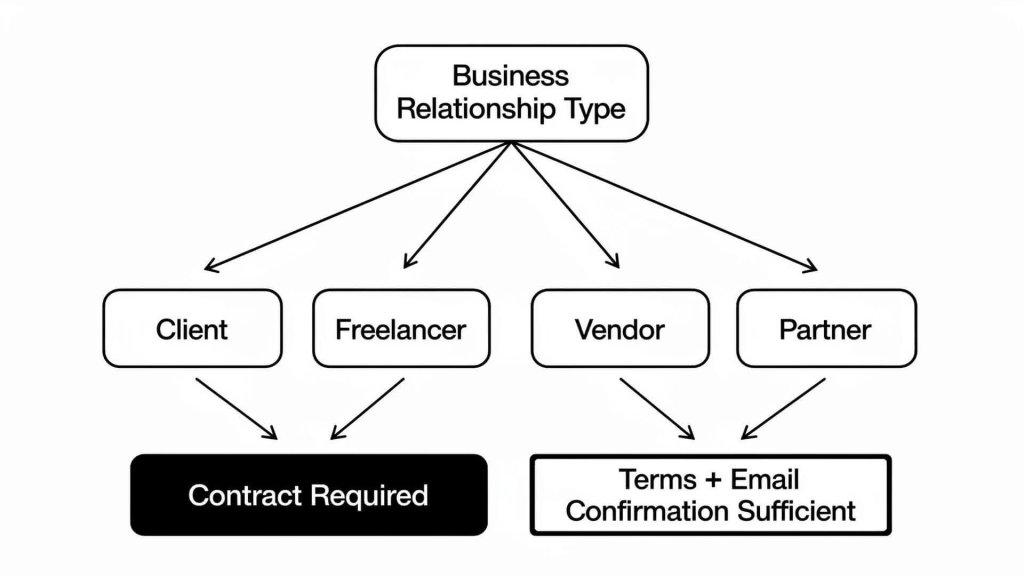
Not every interaction needs a formal contract, but more situations than you think do. Here is a practical breakdown by relationship type.
Clients and Customers
If you are providing a service, whether it is coaching, copywriting, web design, consulting, or social media management, you need a contract. Every time. Even for small projects.
Why? Because scope creep is real. Without a written agreement, a client can argue that extra revisions, additional calls, or new deliverables were “part of the deal.” A contract defines the project scope, payment schedule, revision limits, and what happens if either party walks away.
For digital product sales (eBooks, courses, templates), your checkout page terms and conditions can serve as a lightweight contract. But for anything involving ongoing work or custom deliverables, a separate agreement is necessary.
Freelancers and Contractors You Hire
When you hire someone to build your website, write your content, or manage your ads, you are entering a business relationship with financial and legal consequences. A contract with your freelancers should cover:
- Payment terms and rates
- Project scope and deadlines
- Intellectual property ownership (who owns the work when it is done)
- Confidentiality clauses
- Termination conditions
The IP ownership point is critical. Without a clear clause, a freelancer could legally claim ownership of work they created for you. This is not hypothetical. It happens.
Business Partners
If you are building an online business with someone else, a partnership agreement is one of the most important documents you will ever sign. It should outline ownership percentages, decision-making authority, how profits are split, and what happens if one partner wants to leave.
Handshake deals between friends and friendships. A written agreement protects both of you.
Vendors and SaaS Providers
When you sign up for a software tool, payment processor, or hosting provider, you are agreeing to their terms of service. That is a contract. Read it. Understand what data they collect, whether they can terminate your account, and what liability limitations they include.
For vendors you pay directly (like a supplier for physical products you sell online), negotiate and document your own agreement covering pricing, delivery timelines, and quality standards.
Influencers and Affiliates
If you run an affiliate program or pay influencers to promote your products, put the terms in writing. Cover commission rates, payment schedules, content approval processes, disclosure requirements (which are legally required in most countries), and what content they cannot publish about your brand.
Key takeaway: If money, deliverables, or intellectual property are involved, assume you need a contract. When in doubt, write it down.
How to Evaluate and Customize a Freelance Contract Template
Templates are a practical starting point, but using one without customization is risky. A freelance contract template written for a US-based graphic designer does not automatically apply to a Nigerian content creator or a UK-based coach.
Here is how to use templates responsibly.

Step 1: Check the Jurisdiction Clause
Every template should specify which country’s laws govern the agreement. If the template says “governed by the laws of California” and you operate in Lagos, that clause may not serve you well if there is a dispute. Change it to reflect your actual jurisdiction or add a clause that both parties consent to a neutral jurisdiction.
Step 2: Rewrite the Scope of Work Section
This is the section most people leave vague, and it causes the most disputes. Instead of writing “social media management,” write “creation and scheduling of 12 posts per month across Instagram and Facebook, including captions and static image sourcing. Does not include video production, paid ad management, or community management.”
Specificity protects you. Vague language protects no one.
Step 3: Customize the Payment Terms
Generic templates often use placeholder payment terms. Decide yours deliberately:
- Deposit requirement (50% upfront is standard for many freelance services)
- Milestone-based payments for longer projects
- Late payment penalties (for example, 1.5% per month on overdue invoices)
- Accepted payment methods
Step 4: Add a Kill Fee Clause
A kill fee is a percentage of the total project cost that a client pays if they cancel midway. This compensates you for work already done and the opportunity cost of turning down other clients. A typical kill fee is 25 to 50 percent of the remaining project value.
Step 5: Review the Intellectual Property Clause
The template should clearly state that intellectual property transfers to the client only after full payment is received. Until then, you retain ownership. This clause is your protection if a client disappears after receiving the work but before paying.
Key takeaway: A template is a starting point, not a finished document. Spend 30 to 60 minutes customizing every new template you use for your specific situation.
Contracts for Specific Online Business Models
Different online business models come with distinct contractual needs. Here is what to prioritize based on how you operate.
| Business Model | Key Contract Needed | Critical Clauses |
| Freelance Services | Client Service Agreement | Scope, revisions, kill fee, IP ownership |
| Digital Products | Terms and Conditions (checkout) | No-resale, refund policy, copyright notice |
| Subscriptions | Subscription Agreement | Billing cycle, cancellation terms, data policy |
| Affiliate Programs | Affiliate Agreement | Commission rate, cookie duration, prohibited methods |
Freelance and Service-Based Businesses
Your primary contract is a client service agreement. Beyond the basics covered above, include a communication clause that specifies how feedback is delivered (written only, not verbal), how many rounds of revisions are included, and your response time expectations.
Also include a force majeure clause that protects both parties if something outside their control (illness, technical failure, natural disaster) prevents delivery on time.
Digital Product Sellers
If you sell eBooks, templates, courses, or digital downloads, your Terms and Conditions page on your website acts as a click-through contract. Key elements to include:
- No-refund or limited refund policy and the specific conditions
- Prohibited uses (for example, the buyer cannot resell or redistribute your product)
- Disclaimer of liability for results (important for courses and informational products)
- Copyright notice confirming you own the content
Make sure customers actively check a box agreeing to these terms at checkout, not just a passive notice they can scroll past. Active consent is stronger evidence of agreement.
Subscription Models
If you charge recurring fees, your subscription agreement needs to be especially clear. Specify the billing cycle, what triggers a renewal, how customers can cancel (and by when to avoid the next charge), and what happens to their account and data after cancellation.
In many countries, unclear subscription terms are now a regulatory issue. The US FTC has specific rules on negative option marketing. The EU has consumer protection laws that require easy cancellation. Know the rules for your market.
Affiliate Programs
Your affiliate agreement should cover the commission structure in exact numbers (not “competitive rates”), cookie duration (how long after a click a sale is attributed to the affiliate), prohibited promotional methods (no spam, no misleading claims), and payment thresholds and schedules.
Common Contract Mistakes That Weaken Your Agreements
Even business owners who use contracts make mistakes that reduce their legal protection. Here are the most common ones.
Using Informal Language That Creates Ambiguity
Words like “reasonable,” “timely,” “as needed,” and “approximately” are interpretation traps. Define everything in concrete terms. Instead of “payment due within a reasonable time,” write “payment due within 14 calendar days of invoice date.”
Not Updating Contracts as Your Business Grows
A contract you wrote in year one of your business may not reflect your current pricing, services, or risk exposure. Review your standard contracts at least once a year.
Skipping the Dispute Resolution Clause
What happens if you and a client disagree? Your contract should specify whether disputes go to mediation first, arbitration, or directly to court. It should also specify who pays legal fees in a dispute. Without this, both parties default to the most expensive option: litigation.
Failing to Get Explicit Written Acceptance
An email saying “this looks fine, go ahead” is not the same as a signed contract. Use e-signature tools like DocuSign, PandaDoc, or HelloSign to collect formal acceptance. These platforms create timestamped, auditable records that are much stronger in a dispute.
Treating Your Website Terms as an Afterthought
Your website’s Terms of Service and Privacy Policy are contracts between you and every visitor or customer. If you copied them from another website (a surprisingly common mistake), they may not reflect your actual practices, may not comply with your local laws, and may not protect you in a dispute.
For more on protecting the content you create online, read our guide on Copyright Basics for Content Creators: Protect Your Work Online.
Key takeaway: A weak contract is sometimes worse than no contract because it gives you a false sense of security. Precision and written acceptance matter.
Tools and Resources for Creating Online Business Contracts
You have several options depending on your budget and the complexity of your agreements.
| Option | Best For | Cost Range | Limitation |
| Contract template platforms (Bonsai, AND.CO) | Freelancers and solo operators | $25-$400/month | Templates may not reflect your jurisdiction |
| Legal document services (Rocket Lawyer, LegalZoom) | Small business owners needing standard docs | $30-$100/document | Not a substitute for legal advice |
| Hiring a local business attorney | Partnership agreements, high-value contracts | $150-$500+/hour | Higher cost, but worth it for complex deals |
| DIY using free templates | Very simple, low-stakes agreements | Free | Requires careful customization |
For contracts that govern significant money, partnerships, or intellectual property, hiring a local attorney for at least a one-time review is worth the investment. You are not paying for them to write everything from scratch. You are paying for them to check your customized template for gaps.
If you are in Nigeria, the Nigerian Bar Association directory can help you find a commercial lawyer. In the US, Avvo and LawInfo connect you with attorneys by specialty and location.
For a broader look at the financial side of running your online business, see our guide on Tax Basics for Online Entrepreneurs: What You Need to Know.
Frequently Asked Questions
What to Do Next
Step 1: Audit your current agreements. Make a list of every active business relationship you have: clients, freelancers, vendors, affiliates. Identify which ones have no written contract or only a casual email thread. Prioritize the highest-value relationships first.
Step 2: Choose your contract tools. If you are a freelancer or service provider, sign up for a trial of Bonsai or PandaDoc and explore their templates. Customize at least one core contract this week using the framework in this article.
Step 3: Update your website legal pages. Review your Terms of Service, Privacy Policy, and refund policy. Make sure they reflect your actual practices and that customers actively agree to them at checkout. If you need help structuring your site, see our guide on Essential WordPress Settings: Configure Your Site the Right Way.
Step 4: Clarify your business model before scaling. Contracts are most effective when your overall business model is clearly defined. If you are still working out how your business operates, the Business Model Canvas for Online Entrepreneurs: Plan Before You Build guide will help you clarify your structure before you start formalizing agreements.


