
Most business owners know they need an email list. But knowing that and actually growing one are two very different things. If your opt-in form is sitting on your site getting ignored, the problem usually is not your form placement or your email platform. It is your offer.
The best lead magnet ideas solve a specific problem for a specific person at a specific moment. When you get that match right, strangers become subscribers willingly. This guide covers the most effective lead magnet formats available today, how to match them to your traffic sources, and how to build a repeatable system that grows your list on autopilot.

What Makes a Lead Magnet Actually Work
Before jumping into formats, it helps to understand what separates a lead magnet that converts at 30% from one that barely hits 2%.
The difference comes down to three things.
Specificity: “Free marketing tips” is forgettable. “The 5-email sequence that brought back 47 abandoned carts” is irresistible. Narrow beats broad every time.
Immediate value: The best lead magnets deliver a win fast, ideally within the first five minutes of downloading. If someone has to read 40 pages before they get value, most will not bother.
Relevance to the traffic source: A lead magnet shown to someone reading a blog post about Instagram growth should be about Instagram growth. Matching the offer to the content on the page is one of the fastest ways to double your opt-in rate without changing anything else.
If you are building a wider content strategy around attracting the right visitors in the first place, the SEO Content Strategy: Plan Content That Ranks and Converts guide covers that foundation well.
Lead Magnet Ideas by Format
The formats below range from simple one-page documents to interactive tools. Start with whichever best matches the content you already have, then expand from there.
1. Checklists and Cheat Sheets
Checklists are the fastest lead magnets to create and consistently among the highest converting. People are busy. A one-page checklist that saves someone from having to figure something out themselves is genuinely valuable.
Best for: Blog posts, how-to content, process-driven topics
Example: A post about launching a product could offer a “Product Launch Checklist: 27 Steps to Go Live Without Missing Anything.” That is a direct extension of the content someone is already reading.
Conversion tip: Put the checklist in a simple branded PDF. It does not need to be designed elaborately. Clarity beats polish here.

2. Templates and Swipe Files
Templates remove the blank-page problem. Whether it is an email template, a social media caption template, or a business proposal layout, the value is obvious and immediate.
Best for: Audiences who create things regularly, such as content creators, marketers, and small business owners
Example: If your audience runs e-commerce stores, a “WooCommerce Order Confirmation Email Template” is a highly specific offer with clear utility. This pairs naturally with content about WooCommerce Email Customization: Brand Your Transactional Emails.
Conversion tip: Name your template around the outcome, not the format. “The Email Template That Gets 40% Open Rates” beats “Email Template Download.”
3. Mini Guides and Short Reports (Under 10 Pages)
A focused guide that tackles one specific problem in depth positions you as an authority and gives subscribers something to keep. The key word is focused. A 6-page guide on one narrow topic will outperform a 50-page ebook on a broad one.
Best for: Audiences in research mode, businesses with longer sales cycles, service providers
Example: A “5-Page Competitor Research Playbook for New Online Businesses” is a specific, useful resource. It also connects naturally to your Competitor Analysis for New Businesses: Research Before You Build content.
Conversion tip: Keep it under 10 pages. If you are writing more than that, split it into a multi-part sequence instead.
4. Email Courses and Sequences
An email course delivers value over several days, keeping your brand in front of a subscriber right after they sign up. This is particularly powerful because it does the onboarding work for you.
Best for: Complex topics that need explaining in stages, coaches, consultants, course creators
Example: A 5-day email course called “Build Your First Sales Funnel in 5 Days” works as both a lead magnet and an introduction to your paid offers.
Conversion tip: Day one of any email course should deliver your single best insight. Do not save the good stuff for later. If someone does not open day one, they likely will not open the rest.
Once someone subscribes through an email course, your welcome sequence becomes critical. The Email Welcome Sequence: Onboard New Subscribers Effectively guide shows you exactly how to structure those first emails.
5. Calculators and Interactive Tools
Interactive lead magnets take more effort to build but convert extremely well because they offer personalised value. A calculator that tells someone their potential ROI, estimated monthly revenue, or how long until they reach a goal is more compelling than any PDF.
Best for: Finance, business coaching, health and fitness, real estate, SaaS
Example: A “Monthly Revenue Goal Calculator” that asks for a target income and reverse-engineers how many products or clients someone needs to hit it. People will share tools like that.
Conversion tip: You do not need a developer for basic calculators. Tools like Outgrow or even a well-structured Google Sheet embedded on a page can serve this purpose.

6. Quizzes
A quiz is unique becfause it generates curiosity before the subscriber sees any result. People complete quizzes because they want to know the answer about themselves. That desire to know the outcome is what makes quizzes such strong converters.
Best for: Personal brands, coaches, e-commerce stores (product recommendation quizzes), consultants
Example: “What Type of Online Business Should You Start?” or “What Is Slowing Down Your Website?” Both create intrigue and deliver personalised results.
Conversion tip: Gate the results page behind an email. The quiz itself is the experience. The email address is the price of admission to see the outcome.
7. Free Challenges
A 5-day or 7-day challenge gives subscribers a structured experience and builds community around your brand quickly. Challenges work especially well when your audience needs motivation and accountability, not just information.
Best for: Health and fitness, business growth, productivity, creative skills
Example: “The 5-Day Email List Challenge: Get Your First 100 Subscribers” gives people daily tasks, a sense of progress, and a reason to open every email.
Conversion tip: Keep daily tasks small. If a challenge feels overwhelming, people quit. Small wins build momentum.
8. Resource Libraries
A resource library bundles multiple lead magnets into one gated collection. Instead of offering one checklist, you offer a library of 10 checklists, templates, and guides. The perceived value is higher, even if individual items are of similar quality to what you would give away separately.
Best for: Established content creators, blogs with multiple content pillars, online educators
Example: “The WNS Digital Hub Resource Vault: Templates, Checklists, and Guides for Online Business Owners” as a single opt-in that unlocks everything.
Conversion tip: Start with three to five resources in your library. Launch it before it feels “complete.” You can always add more over time.
9. Discount Codes and Free Trials
For e-commerce and SaaS businesses, a discount or free trial is often the most direct and effective lead magnet available. There is no education required. The value is immediate and tangible.
Best for: Online stores, subscription businesses, software products
Example: “Get 15% off your first order when you join our email list.” This is simple, direct, and works because the offer matches exactly where the visitor is in their decision-making process.
Conversion tip: Pair a discount opt-in with an exit-intent trigger. When someone is about to leave your product page, that is precisely the moment a discount offer is most persuasive. For more on that tactic, see Exit Intent Strategies: Capture Leaving Visitors Effectively.

10. Webinars and Workshops
A free live webinar or recorded workshop is a high-perceived-value lead magnet that also pre-qualifies subscribers. Someone who registers for a 60-minute training on your topic is far more invested than someone who downloaded a PDF.
Best for: High-ticket services, B2B businesses, coaches, consultants
Example: “Free Workshop: How to Set Up Automated Email Sequences That Sell While You Sleep” speaks directly to a pain point and promises a specific skill.
Conversion tip: Promote the webinar to your existing list first. Let current subscribers invite others. This builds your list while rewarding people who are already engaged.
Matching Lead Magnets to the Customer Journey
One of the most overlooked lead magnet strategies is matching your offer to where someone is in their journey with you. The same person browsing your blog for the first time needs a different offer than someone who has read three of your posts and is comparing you to a competitor.

Awareness stage: This is someone landing on a blog post for the first time. They do not know you yet. Keep the ask low. A checklist, cheat sheet, or short guide works well here. The goal is to get them on your list, not to close a sale.
Consideration stage: This person has been around a while. They are comparing options and thinking more seriously. An email course, webinar, or detailed guide works here because they are willing to invest more time in exchange for more value.
Decision stage: This person is close to buying. A free trial, discount code, or consultation offer makes sense. The lead magnet here is designed to remove the final objection before purchase.
Most businesses make the mistake of using one lead magnet for all traffic. Segmenting your offers by stage will meaningfully improve both opt-in rates and downstream conversions.
How to Create a Lead Magnet Quickly Without a Big Team
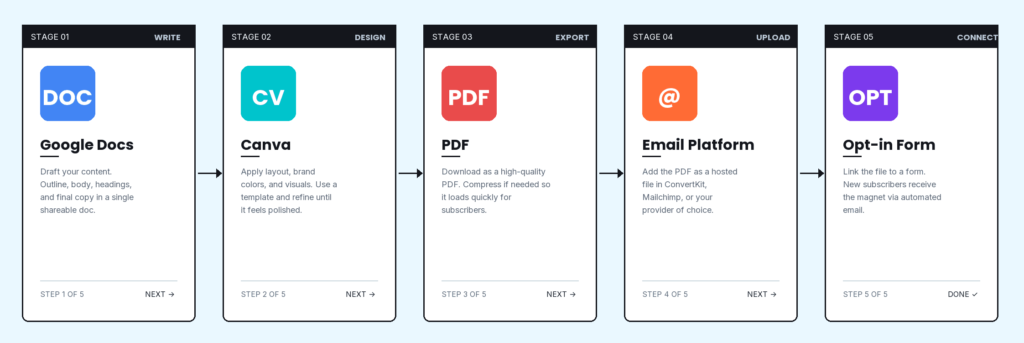
You do not need a designer, a developer, or weeks of work to create a strong lead magnet. Here is a realistic process for building your first one in a single day.
Step 1: Pick one specific problem your audience has. Look at the questions in your blog comments, your customer emails, or Facebook groups in your niche. Find a recurring question and answer it.
Step 2: Choose the simplest format that solves it. If the problem needs a process, use a checklist. If it needs context, use a short guide. If it needs personalisation, consider a quiz. Do not overthink the format.
Step 3: Create the content in Google Docs first. Write the substance before you worry about design. Most lead magnets are over-designed and under-written.
Step 4: Turn it into a PDF using Canva or Google Docs itself. Canva has free templates for lead magnets. A clean layout with your logo, clear headings, and readable body text is all you need.
Step 5: Upload it and connect it to your opt-in form. Your email platform (ConvertKit, Mailchimp, ActiveCampaign, and similar) will handle the delivery automatically once connected.
For business owners managing a WordPress site, tools like custom fields can help you personalise opt-in experiences for different visitors. The Custom Fields in WordPress: Add Extra Data to Your Content guide covers that level of customisation if you are ready to go deeper.
Building a Scalable Lead Magnet System
The goal is not to create one lead magnet and stop. A scalable system uses well-matched lead magnet ideas across every stage of your site, turning consistent traffic into a predictable email growth engine.
Here is what that looks like in practice.
Content-specific lead magnets: Every major blog post or content cluster gets its own lead magnet. A post about SEO gets a keyword research checklist. A post about email marketing gets an email sequence template. This is called a content upgrade and it consistently outperforms generic sitewide opt-ins.
Pillar page lead magnets: Your most important, high-traffic pages get more substantial offers. A resource library or detailed guide lives here.
Exit-intent offers: A separate lead magnet fires when someone is leaving. Often a discount or a high-value quick-win resource works best in this position.
Post-purchase or post-download sequences: Once someone is on your list, the next step matters enormously. A strong welcome sequence turns new subscribers into engaged readers and eventually buyers. This is where your email system starts working for you around the clock.

If you manage an e-commerce operation alongside your email list, streamlining how these systems connect is worth the effort. The E-commerce Operations Guide: Streamline Your Online Business covers the operational side of scaling these moving parts.
Frequently Asked Questions
What to Do Next
1. Audit your current opt-in offer. If you have one already, check its conversion rate. An average opt-in form converts at 1 to 2%. Anything above 5% is strong. If you are below 1%, your offer likely needs to change before anything else.
2. Choose one lead magnet format and create it this week. Pick the format that matches your best-performing piece of content. Write the content in Google Docs, design it in Canva, and connect it to your opt-in form. Done is better than perfect.
3. Set up your welcome sequence. A lead magnet gets someone on your list. Your welcome sequence is what builds the relationship. Follow the Email Welcome Sequence: Onboard New Subscribers Effectively guide to turn new subscribers into engaged readers from day one.
4. Add an exit-intent offer to your highest-traffic pages. Once your primary lead magnet is live, add a second offer that fires when visitors are about to leave. Use Exit Intent Strategies: Capture Leaving Visitors Effectively to set this up without needing a developer.


